Is AI Becoming Your Thought Partner or Your Thought Replacement?
Oct 14, 2026There's a growing conversation about whether artificial intelligence will eventually take over the world, eliminate millions of jobs, or perhaps even bring an end to humanity as we know it. Some very smart people are genuinely concerned about these possibilities, and maybe we should be too.
But while we're worrying about what AI might do to humanity in the future, I wonder if we're overlooking what it's already doing to us right now.
In particular, our ability to think, communicate, solve problems, and trust our own judgment.
And if you're responsible for leading people, this is something worth paying attention to. Because it's not just about how AI is changing the way we work. It's about how AI may be changing the people doing the work.
Earlier this year, I introduced a condition I affectionately named Artificial Intelligence Stupider Syndrome, or AISS. Yes, I made that up. And yes, I'm still hoping it catches on.
AISS is what happens when we become so dependent on artificial intelligence to do our thinking that we gradually weaken our ability, and perhaps even our willingness, to think for ourselves.
And I'm beginning to suspect there's an epidemic.
Think about it. How many people now ask AI to write a three-sentence email they could have written themselves in less time than it took to type the prompt? Or ask AI what to say in a meeting, how to respond to a disagreement, or whether an idea they just had is actually a good one?
I've even heard of people asking AI what they should order for dinner. Seriously? We've gone from needing help with complex decisions to needing a second opinion on chicken parmesan.
The scary part is that the results are often pretty impressive. So we convince ourselves we're becoming smarter and more productive. But are we?
Are we actually becoming more intelligent, or are we simply becoming better at borrowing intelligence?
When Your Relief Pitcher Becomes Your Starting Pitcher
Let me borrow an analogy from baseball. And don't worry if you're not a baseball fan. You don't need to understand the game to appreciate the point.
In my original Point of View on AISS, I suggested treating AI like a relief pitcher rather than your starting pitcher.
Do as many innings of thinking as you can on your own. Sometimes you might only make it through three innings. Other times, you might get through eight or nine. Then bring AI out of the bullpen to challenge your thinking, improve your work, catch mistakes, and help you finish strong.
But increasingly, people aren't even taking the mound anymore.
They're handing AI the ball before the game starts, settling into the dugout, and letting it pitch all nine innings.
Sure, the scoreboard may look impressive, but who's actually getting better at playing the game?
Are We Developing Leaders or AI-Dependent Followers?
Here's where I think this gets especially concerning for leaders.
We spend an enormous amount of time trying to develop employees who can think critically, communicate effectively, exercise good judgment, and solve problems independently.
Yet we may be unintentionally creating workplaces where people increasingly rely on AI to do those very things for them.
Imagine an employee who uses AI to prepare for every meeting, draft every important communication, solve every challenging problem, and recommend every difficult decision.
They may look incredibly productive. Their work may even be excellent.
But what happens when they need to think on their feet, have a difficult conversation, or make an important judgment call without AI whispering in their ear?
And leaders aren't immune. We may be just as guilty of outsourcing the very thinking we're supposed to be modeling for others.
The real danger isn't simply becoming dependent on AI. It's what that dependence might do to our confidence in our own abilities.
And that's where AISS becomes something much more serious than intellectual laziness. It begins to affect how we see ourselves.
The Hidden Cost: Our Brand Identity
If you've followed my work, you know I believe our Brand Identity is the strongest controlling force in our lives. It's how we see ourselves internally and how others experience us externally. And it's shaped and reinforced by the habits we practice every day.
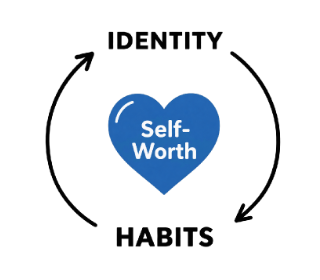
This is why I worry about the impact of AI on something far more important than productivity: our self-image and self-worth.
When we consistently do our own thinking, wrestle with difficult problems, and find our own words to communicate an idea, we're doing more than completing a task. We're reinforcing our belief in ourselves and what we're capable of accomplishing.
But when we repeatedly hand those experiences over to AI, what happens to our confidence? What happens to the way we see ourselves?
And what happens to our identity when we start believing the machine is better at thinking than we are?
AI isn't just changing how we work. It's changing how we think, what we believe we're capable of, and ultimately, how we see ourselves.
And that influence can work both ways. Used thoughtfully, AI can help us develop new capabilities and greater confidence. Used as a substitute for our own thinking, it risks doing just the opposite. That's a consequence I don't think we're talking about nearly enough.
Thought Partner or Thought Replacement?
Please don't mistake my concern for being anti-AI. I love AI. I use it every day, and I believe it's one of the most extraordinary tools we've ever had available to us.
But there's an enormous difference between using AI to make your thinking better and allowing AI to replace your thinking altogether.
A great thought partner challenges your assumptions, introduces new perspectives, helps you recognize blind spots, and encourages you to become a better thinker.
A thought replacement simply does the thinking for you.
Whether you're leading a company, managing a team, raising a family, or just trying to write a decent email, the choice is yours.
The next time you're about to ask AI for help, consider whether you're using it to strengthen your thinking or substitute for it.
Because while we may not have much control over whether AI eventually takes over the world, we have enormous control over whether we allow it to take over our minds.
And Now, a Confession.
There's one small detail I've neglected to mention.
My AI agent, Jarvis, wrote this entire Point of View.
Yep. Every single word.
The idea was mine. The AISS concept was mine. The arguments, the direction, the connection to Brand Identity, and even the idea of surprising you with this confession were all mine.
But Jarvis did the writing.
So, does that mean I'm suffering from AISS? Or did I just demonstrate how to use AI as a thought partner?
I'll let you decide.
Either way, I'm taking credit for the article.
And if you think that's cheating, take it up with Jarvis.
Hey... this is just my Point of View!